


Buying Real Estate in Mexico vs. the United States: Key Differences
Ownership, the notario, escrow, title, financing and costs, side by side.
By Lance Fulford5 min read
If you have bought a home in California, you already know a lot about buying one. But some of what you know does not carry across the border. Mexico has its own ownership rules, its own closing official and its own way of moving money and checking title. Here are the differences side by side, so nothing catches you off guard.
The short version
| United States (California) | Mexico (coastal, e.g. Puerto Vallarta) | |
|---|---|---|
| Who can own | Anyone can hold title directly | Foreigners hold coastal homes through a bank trust (fideicomiso) |
| Closing official | Escrow and title company | Notario público, a state-appointed lawyer, plus optional escrow |
| Title protection | Title insurance is standard | Title review by the notary; title insurance is available but less common |
| Listing data | Comprehensive regional MLSs | Local MLSs exist, but coverage is less complete |
| Financing | Mortgages are the norm | Cash purchases are common for foreign buyers |
| Buyer closing costs | Lender, title and escrow fees; transfer tax often negotiated | Usually 5–8% of price, mostly paid by the buyer, including the acquisition tax |
Ownership: direct title vs. the bank trust
In the U.S., a foreign buyer can generally hold title like anyone else. In Mexico, Article 27 of the Constitution bars foreigners from holding direct title to land within 100 kilometres of a border or 50 kilometres of the coast, the "restricted zone". Coastal homes such as those in Puerto Vallarta are therefore held through a fideicomiso. A Mexican bank holds title as trustee, with a permit from the Ministry of Foreign Affairs, and you hold the rights to use, rent, sell and bequeath the property. The trust can run for up to 50 years and is renewable. Read The fideicomiso, explained.
The closing: escrow company vs. notario público
In California, escrow and title companies run the closing and record the deed. In Mexico, the central figure is the notario público, who is nothing like an American notary public. The notario is an experienced lawyer appointed by the state, responsible for the legality of the transaction. The notario reviews title, obtains a certificate of no liens from the Public Property Registry, confirms that taxes and fees are paid, orders the tax appraisal, calculates and collects the transfer taxes, drafts the deed (escritura) and records it.
Escrow still matters. In Mexico it is a separate service you arrange to protect your money until closing. MLSVallarta, the local MLS association, recommends escrow for every transaction.
Representation: agents and lawyers
California agents are licensed by the Department of Real Estate. Mexico's industry is organized differently. AMPI, the Mexican real estate association, is described by the U.S. National Association of Realtors as the Mexican equivalent of NAR. Because the notary represents the legality of the deed rather than either party's interests, buyers in Mexico should also retain their own independent real estate attorney.
Due diligence: who checks what
In California, much of a buyer's protection comes from mandatory seller disclosures (the Transfer Disclosure Statement, the Natural Hazard Disclosure and others) and from title insurance. In Mexico, don't assume the same disclosure regime applies. Plan to do more of the checking yourself: through your attorney, the notary's certificates, an independent inspection and, for condominiums, a review of the building's finances. Our Puerto Vallarta condo guide covers what to request.
Money: mortgages vs. cash
Many U.S. purchases are financed with a mortgage. Foreign buyers in Mexico often pay cash or raise funds at home, because cross-border mortgages are less common and usually have stricter terms. Plan international transfers early, and route them through escrow.
Costs and taxes
- Closing costs. In Mexico, the buyer usually pays the acquisition tax (set by each state, ranging from about 1% to 4% of the tax value), plus notary fees, appraisal, registration and the bank-trust setup. Local brokers estimate 5–8% in total. In San Francisco, closing costs include title, escrow and lender fees, and the city's transfer tax, which the contract allocates.
- Annual property tax. California's Proposition 13 sets a base rate of 1% of assessed value plus local charges, with annual increases generally capped at 2%. In Puerto Vallarta, the annual predial is typically far lower in dollar terms. Local brokers describe it as often a few hundred dollars a year.
- When you sell. Each country taxes capital gains under its own rules, and U.S. citizens report worldwide income. Get cross-border tax advice before you buy, not when you sell.
- U.S. reporting. In Revenue Ruling 2013-14, the IRS concluded that a Mexican land trust used simply to hold title is not a trust for foreign-trust reporting purposes. Ask your advisor how it applies to you.
Timeline
A cash purchase in Mexico can move quickly once the trust permit is issued. The Ministry of Foreign Affairs' guidance gives it five business days to decide. The recorded deed, however, may arrive weeks or months after closing. In California, escrow typically runs to an agreed contract timeline, often driven by financing.
What stays the same
Good decisions still rest on the same basics: the right neighborhood, a thorough inspection, independent advice, and a clear understanding of what the home will cost to own.
One advisor for both sides
Lance Fulford works in both San Francisco and Puerto Vallarta, so he can explain each system from the buyer's side. Start with our guide to buying in Puerto Vallarta as an American, or ask Lance a question.
General information only, not legal or tax advice. Confirm the details with qualified professionals in each country. Last reviewed October 2026.
Sources: Secretaría de Relaciones Exteriores – Restricted-zone trust permit; Ley de Inversión Extranjera, Article 11; MLSVallarta – Buying real estate in Mexico; National Association of Realtors – Doing business with Mexico; Coldwell Banker La Costa – Cost to buy property in Puerto Vallarta; California BOE – Publication 29; City and County of San Francisco – Transfer tax; Freeman Law – Tax implications of buying in coastal Mexico. Accessed 23 October 2026.
A question about your own situation?
Lance is glad to talk it through, with no obligation.
Get in touch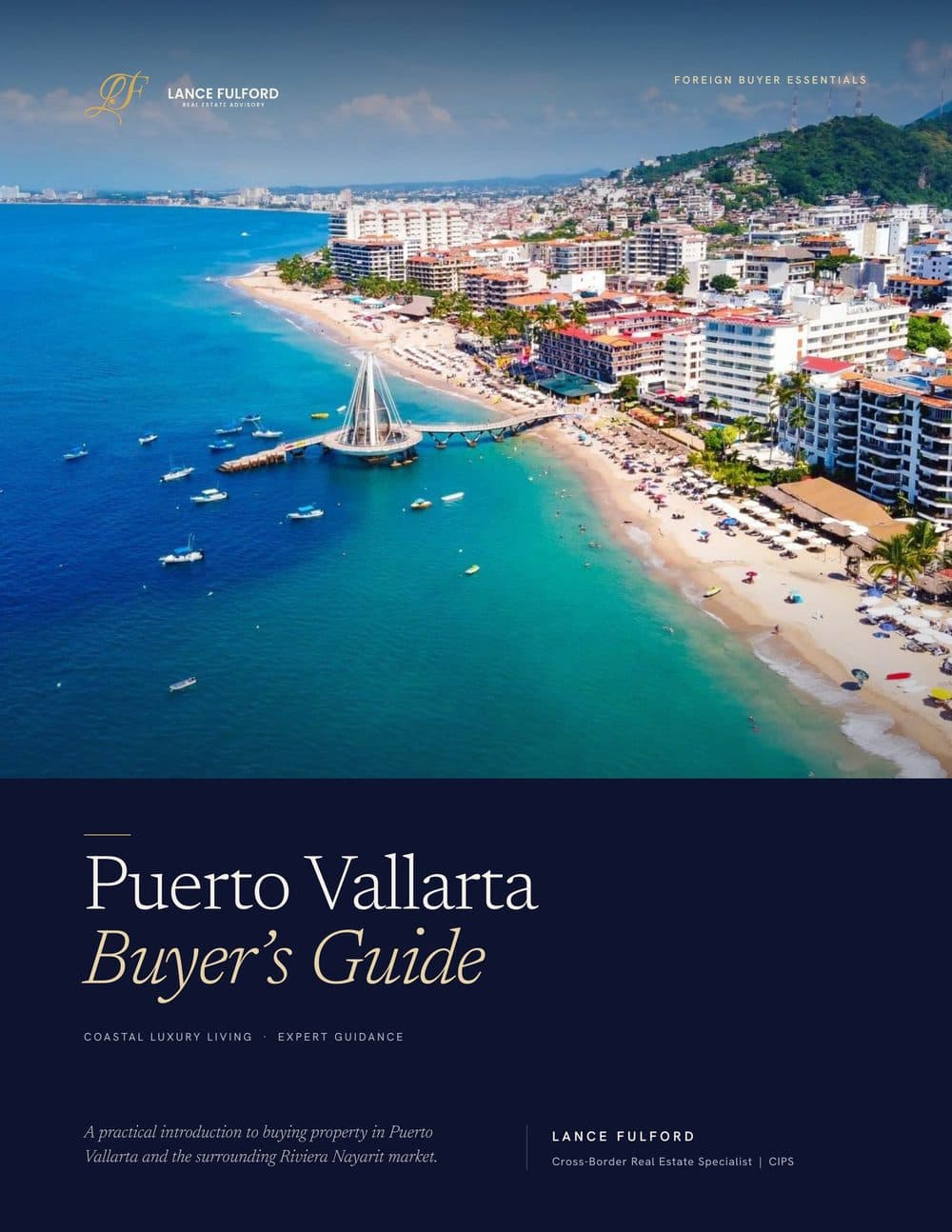
Free guide for cross-border buyers
The Puerto Vallarta Buyer’s Guide
Lance’s 16-page guide for U.S. and Canadian buyers: how ownership works, how a purchase comes together, and what to check before you commit.
- How foreigners own coastal property through a fideicomiso
- The buying process, from your brief to the keys
- Insurance, financing and moving funds safely
- Property types, neighborhoods and buyer checklists